
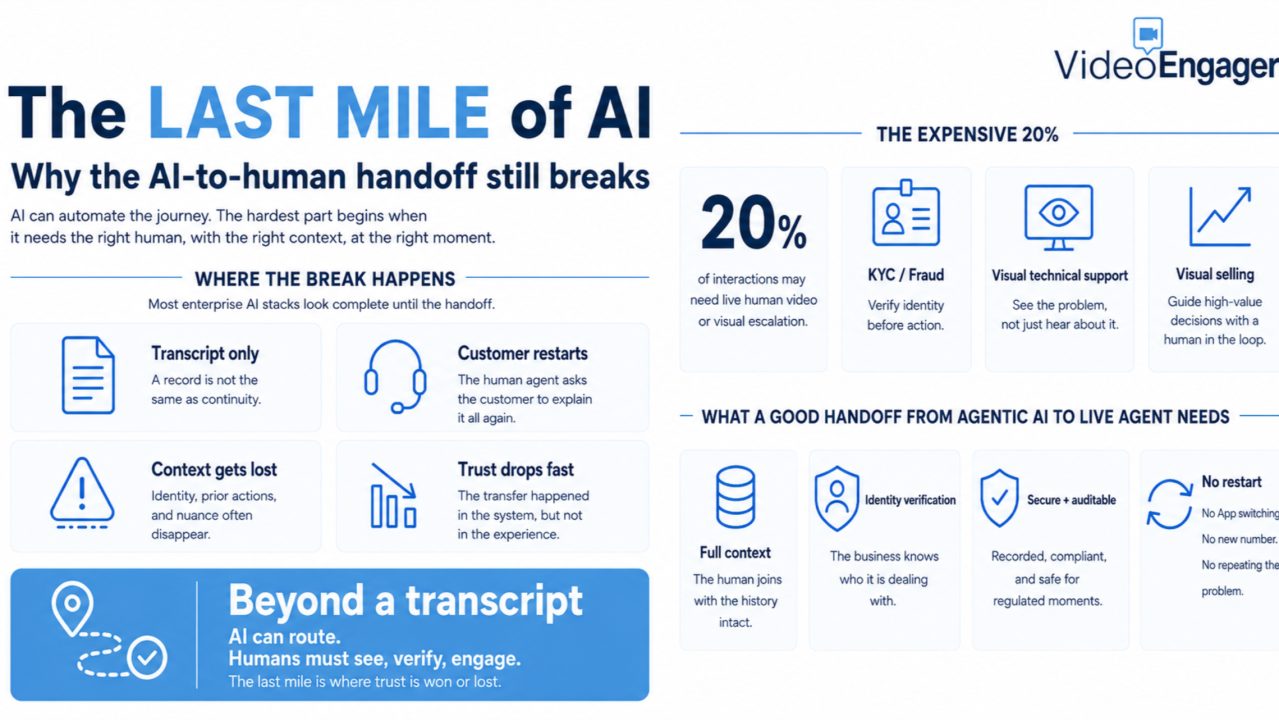
The last mile of AI

Why the AI-to-human handoff still breaks
I was a member of the dot-com boom, and so the current environment surrounding agentic AI feels familiar to me. There is significant development occurring, without question. There is also a great amount of money being invested in anything with AI associated with it, especially in text,voice and orchestration.
Another business emerges every week with a better agent, a faster model, or a novel method to automate work previously completed by individuals. Some of these businesses will develop critical technology, and others will vanish once the market becomes less tolerant. We have witnessed that cycle before. My interest lies in the aspect that receives considerably less attention.
What happens after an AI agent determines that it’s hit a wall and requires a human?
The majority of enterprise AI diagrams appear reasonably complete. At the base, you will find cloud infrastructure, networks, and WebRTC. Foundation models, speech systems, and multimodal reasoning exist above that, then enterprise applications such as CRM and contact center platforms follow those. Organizations are developing AI agents on top of those platforms that can respond to inquiries, execute tasks, make decisions, and route customer interactions.
Following those steps, the diagram reaches the customer. Somewhere between the AI agent and a reliable human outcome, there is still a noticeable gap. The market often refers to this as escalation to live agent. I believe that term implies that the process is simpler than it truly is. Escalation refers to generating a ticket, or to sending a transcript to an agent. Transferring someone from an AI to a contact center queue is also considered escalation.
So far, the majority of those actions ensure that the customer connects with an individual who understands what happened prior to their involvement, can authenticate their identity, and is authorized to address the problem.
The last mile
Delivery's last mile in logistics is frequently the most expensive and challenging leg of the journey. The package has traversed countries, warehouses, and distribution centers; however, delivering it to a single person's residence creates the most friction. The broadband industry experiences the same issue. Developing the larger network presents one challenge, but connecting the ultimate property presents another.
Agentic AI is beginning to encounter its own rendition of that issue. The model has deduced, the agent has automated, and the orchestration platform has determined that human participation is essential. The workflow must now deliver the human.
The expensive twenty percent
Truth to be told, live video escalation is unnecessary for each AI interaction. It would be absurd to suggest otherwise, and so the majority of routine inquiries should be automated. If a customer wishes to verify a delivery date, update a preference, or obtain fundamental information, the AI should provide assistance. Incorporating a live video agent would lead to additional cost and inconvenience for all parties involved. That requirement appears in a limited number of interactions, possibly twenty percent of the total within appropriate enterprise environments.
Nevertheless, that represents a substantial, growing market since these interactions typically carry the greatest risk or commercial significance. Those interactions generally fall within three primary categories: KYC/Fraud detection, visual technical support and visual selling. A bank might require authenticating identity before discussing a transaction. A support agent might require viewing a malfunctioning appliance, a piece of industrial equipment, or a malfunctioning device. An insurance company might require inspecting damage. A health care professional might require seeing the patient. A retail advisor might require demonstrating a complex or expensive product. In each instance, the AI can progress the conversation significantly, it can gather information, pose sensible questions, and determine what should happen next.
Ultimately, however, someone must view something, authenticate something, or render a judgment that the organization is unwilling to delegate entirely to software. Those are moments of trust. As AI progresses in capability, it will encounter more such moments. That statement may appear contradictory; however, it is already evident. Superior automation does not eliminate every instance requiring human participation. Rather, it redirects humans toward cases that are more intricate, more sensitive, and more consequential.
Routine tasks are eradicated first, and any other work that remains is more difficult. The reason why a fraud dispute might be challenging is because the bank must establish identity, comprehend the context, adhere to regulatory guidelines, and ascertain which action is warranted. Or another example: a health care interaction is challenging because someone may need to observe them, interpret ambiguity, and assume accountability for subsequent decisions. AI can assist with all of this. I am not advocating against AI; nor is VideoEngager. I am advocating against assuming that a routing decision concludes one hundred percent of the tasks.
Beyond a transcript
I think we can all agree that a handoff encompasses more than a simple transcript. Genesys, Salesforce, Amazon Connect, ServiceNow , Verint and similar orchestration platforms can become highly skilled at determining when a conversation should transition from an AI agent to a person. They already manage complex customer journeys across voice, messaging, and contact center systems. The unresolved component arises subsequent to that transition. A customer may spend several minutes articulating a problem to an AI agent, the system acquires their details, validates an account, excludes several potential remedies, and ultimately elevates the interaction. A human agent appears and inquires, "How can I assist you?" The customer must recommence.
From an infrastructure perspective, the transfer took place. From the perspective of the customer, no transfer occurred except for the responsibility of articulating the problem twice. A transcript aids, although individuals within the industry frequently discuss transcripts as if they resolve continuity independently. They do not. A transcript is a documentation, and so the incoming agent must locate it, read it, comprehend which components are pertinent, and ascertain what actions the AI has undertaken previously. An AI-generated summary can conserve time; however, summaries make judgments concerning what to exclude. This is acceptable in numerous routine customer service interactions, but it becomes riskier when the omitted detail pertains to fraud, health, identity, or regulatory compliance, audio sentiment analysis or photos/frames collected before the human gets in the loop.
A beneficial AI-to-human handoff must preserve the active interaction. The human should enter into the interaction with context obtainable within the system they currently utilize, whether Genesys, Salesforce, ServiceNow or another CSaaS or CRM enterprise platform. The customer should not be requested to depart from the website, download a separate application or call an alternate telephone number because the issue has evolved in complexity. This explains why we characterize VideoEngager as video infrastructure rather than a video application.
Human in the loop
Ultimately, when an AI agent encounters a scenario involving identity verification/risk assessment/visual evidence/high-value decision-making, an enterprise requires more than an escalation flag. It requires appropriate human intervention with intact context, an organization to identify its customer, and an interaction to remain secure/recorded/auditable.
Lastly, it requires all of that to occur without compelling a customer to restart. AI companies invest considerable sums in developing machine reasoning/speaking/acting capabilities. The final mile ensures humans are in the loop appropriately.
Continue reading
Experience It Yourself
Experience the power of VideoEngager AI with a free trial or request a demo now!