
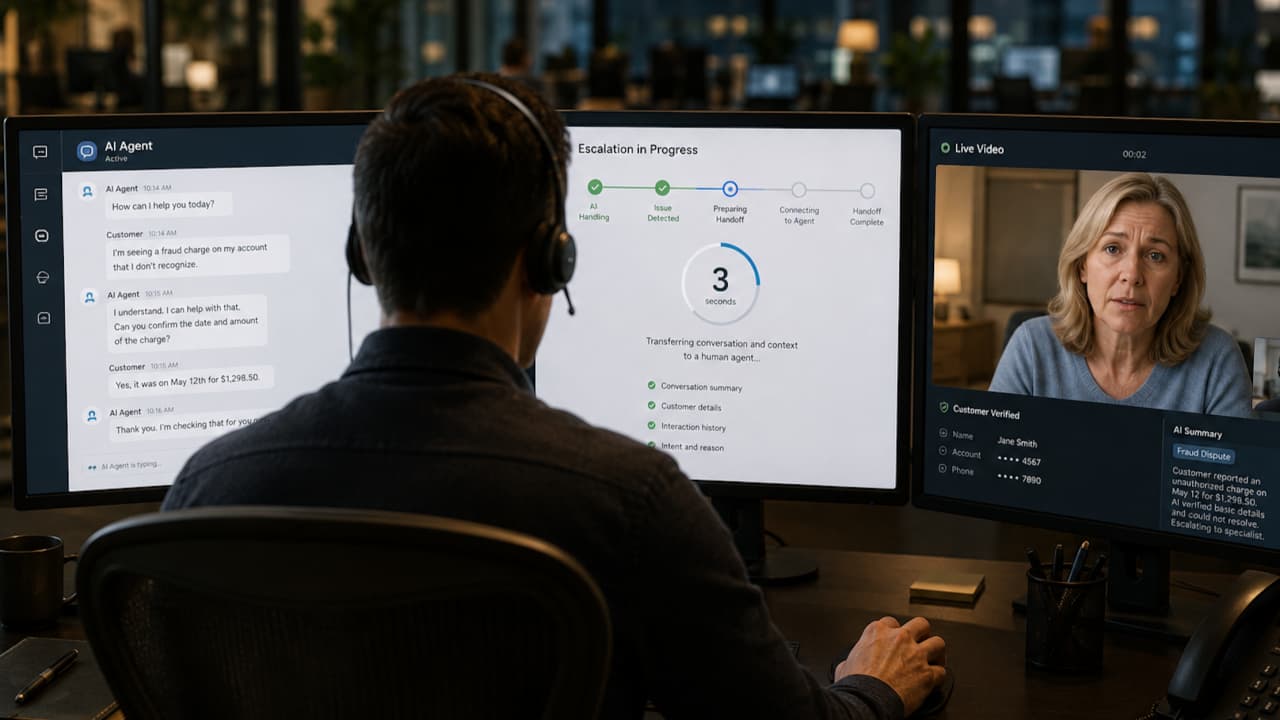
What happens in the three seconds before an AI agent hands off to a human

A customer is on hold with a bank. The AI agent has handled the first four minutes well enough, then something goes wrong that the AI cannot resolve. This could be a fraud flag or a compliance question.
AI then hands off to a person.
Now, this is the question nobody in this industry wants to answer honestly: what does the human agent actually receive in that handoff? A transcript, maybe, and a ticket number. Sometimes nothing at all beyond “customer transferred, reason unclear.”
The customer has to start over. Explain the fraud flag again, repeat the account number again, say, out loud, for the second time, that they are scared their savings are gone. This is the norm, not the exception: in Glance’s 2026 CX Trends survey of more than 600 US consumers, only 7 percent said they rarely or never have to repeat themselves when switching channels.
That three-second gap between AI and human is where trust gets made or lost. Not in the AI’s answer or in the human agent’s skill but in the handoff itself.
Why this keeps happening
Most AI deployments were built to reduce headcount, not preserve context. The AI’s job was to handle as much volume as possible before a human ever got involved. Escalation was treated as a failure state, something to minimize rather than something to design well.
That worked while AI stayed simple. It stops working as soon as AI gets good enough to touch regulated, high stakes conversations; for example in banking, healthcare, or government services. Gartner predicts agentic AI will autonomously resolve 80 percent of common customer service issues by 2029, which means the conversations that still reach a human will be, by definition, the hardest ones.
The moments where a bad handoff doesn’t just annoy a customer, but it creates a compliance problem, a fraud exposure, or a customer who never comes back.
I have spent close to five decades building software companies, four of them acquired by public companies before this one. I have never seen a category move this fast with this little attention paid to the exit point of the conversation, the actual second when AI stops and a person starts.
What a good handoff actually requires
A good handoff continues the conversation instead of restarting it. The human agent needs to see everything the AI saw. What the customer asked, what the AI understood, where the confusion started.
Ideally, the human should be able to step into a live video conversation with the customer, inside the same system the agent already works in, with the full context sitting right there. No new tab or asking the customer “can you repeat that.”
This is the layer most AI orchestration stacks are missing. Everyone is building the AI but almost nobody is building the handoff.
This is what VideoEngager operates. AIBot2Human by VideoEngager sits inside the CX stack, integrated directly with Genesys, Amazon Connect, Salesforce, Five9, Zendesk, Talkdesk, and Verint, so that when an AI agent cannot finish the job, a human agent can step into a video conversation with full context intact. The agent sees a summary of the AI conversation before they say a word, on infrastructure already compliant with GDPR, HIPAA, PCI, ISO 27001, and SOC 2 type two. No lost thread or a frustrated customer having to repeat themselves to a stranger who just picked up mid-crisis.
What this looks like when it works
BAC CREDOMATIC, a financial group operating across six Central American countries, runs millions of video calls a year through this kind of handoff inside Genesys Cloud and has cut fraud by 60 percent in the process. That number is not about the video technology being clever. What’s imperative is a customer being able to show their face, their ID, at the exact moment fraud teams need certainty instead of a voice on a phone line. As BAC’s Service Channels Corporate Director, Cinthya Moreno Gomez, put it: “We have managed to place key customer information on the agent’s screen, providing them with insights and enabling them to make real-time decisions.” That is what a handoff with context looks like in production.
A dental implant provider we work with saw something different but related. Once the human handoff moved to video, close rates rose to 54 percent and deal sizes went up 35 percent, while time spent coordinating patient travel dropped by 35 percent. Sales teams doubled headcount to keep up with the volume, and the whole system went live in 45 days. That’s a trust story at its core. People commit to expensive, personal decisions faster when they can see the person on the other end.
Both cases share the same mechanism underneath them. The AI does the volume and the human does the moment that actually needs a human. And nothing gets lost in between.
The real cost of getting this wrong
Every enterprise I talk to has already run the math on their AI failure rate. Almost none of them have run the math on their handoff failure rate, the cost of a customer who has to re-explain themselves, the compliance exposure of an ungoverned transfer, the agent who inherits a conversation with zero context and has to rebuild trust from nothing.
That cost is invisible on a dashboard. Customers, though, have already run the numbers for you: 75 percent say a fast AI-driven answer has still left them frustrated, and nearly 90 percent report their loyalty drops when human support is taken away It shows up later, in churn, in complaint volume, in the customer who stops calling and starts looking at your competitor instead.
(Source: https://www.glance.cx/blog/75-of-consumers-left-frustrated-by-ai-customer-service)
Where this is heading
The platforms building agentic AI right now, the ones spending billions acquiring capability instead of building it themselves (NiCE alone paid 955 million dollars for Cognigy, now NiCE Cognigy, last year), are going to hit this same wall. AI can carry a conversation a long way. It cannot yet manage the moment where a human has to look someone in the eye, virtually or otherwise, and say, I’ve got this from here.
That crucial moment is the whole business. Get it right and customers trust you with the next crisis too. Get it wrong and no amount of AI sophistication upstream will save the relationship.
If you are building or buying agentic AI for a regulated, high stakes environment, the handoff is not an afterthought. It is the part of the system your customers will remember.
Continue reading
Experience It Yourself
Experience the power of VideoEngager AI with a free trial or request a demo now!